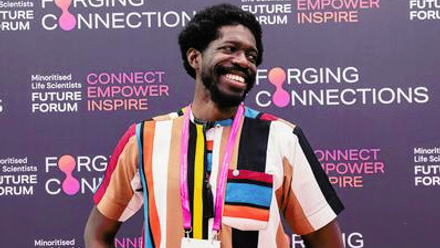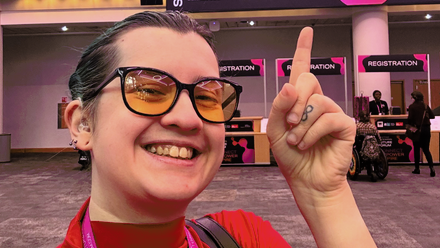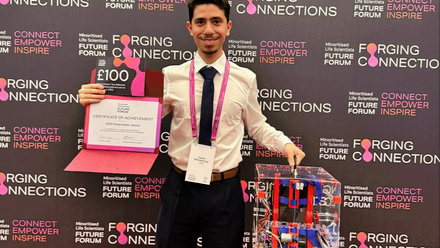
I was told I would never be a scientist: disability and LGBTQIA+ advocate Max Fisher tells their story
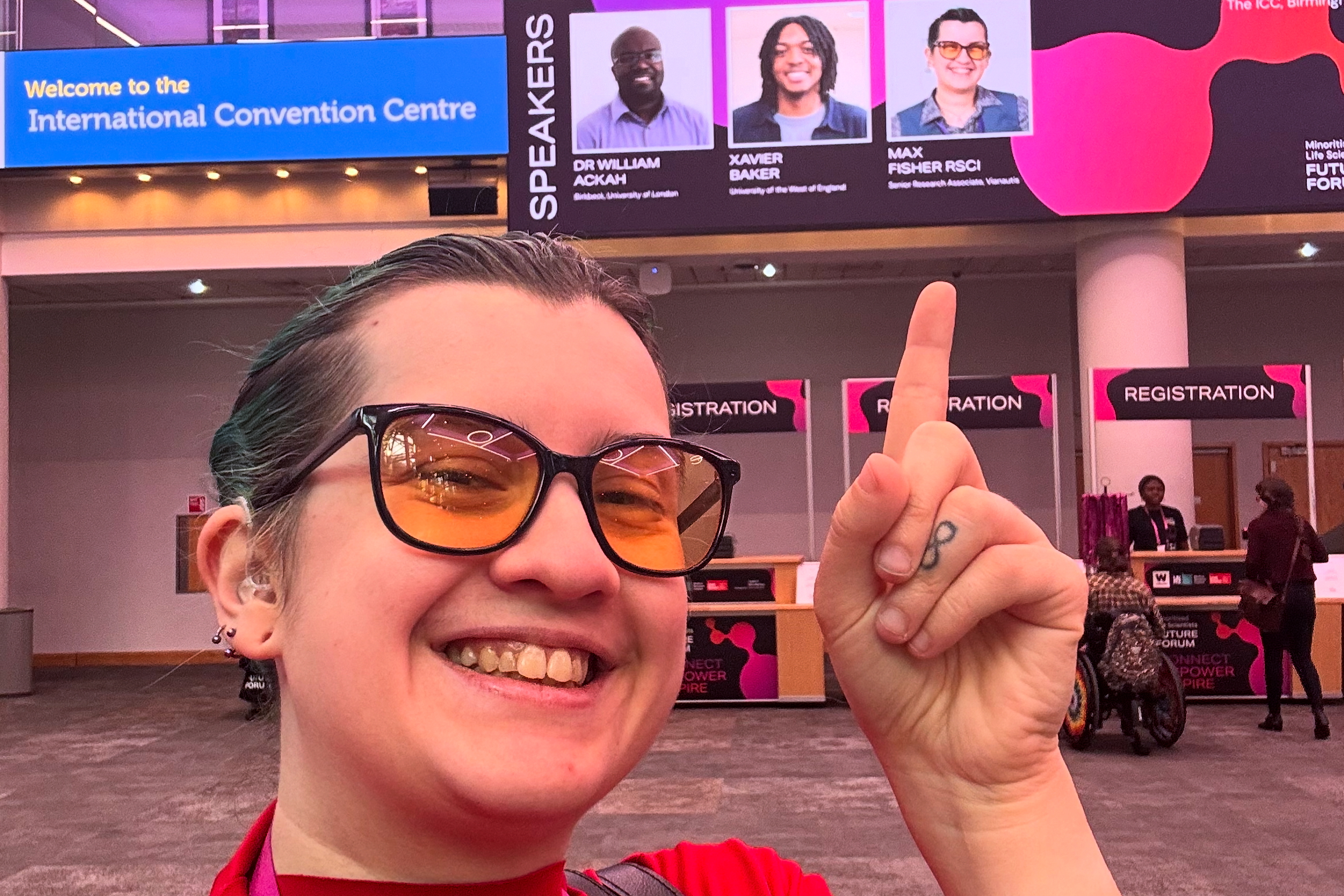
Leading disability & LGBTQIA+ advocate Max Fisher, a Senior Research Associate at ViaNautis Bio, opens up on their STEM journey - and how it led them to MLSFF.
I became a scientist because I am disabled. For as long as I can remember, I have lived with chronic pain, alongside other symptoms.
Doctors didn’t seem to know what was wrong, because as it turns out, I was living with a rare disease called Ehlers-Danlos Syndrome, which is currently untreatable. Because of this lived experience, I wanted to be a part of a team that would eventually create drugs for diseases without cures. I decided to pursue a career in pharmacology.
When I was 17 I was a part of a scheme that allowed me to conduct a pharmacological research project within a hospital in order to give me a taste of what my future could look like. And I loved it.
University journey
I then went to Nottingham Trent University to study Pharmacology for my undergraduate degree (BSc (hons)), followed by a Masters by Research (MRes) also in Pharmacology. During my time at university, my disabilities became more apparent and I started using a wheelchair.
I got involved with my student union as their elected Equality and Diversity Officer for Gender. I was able to run a series of intersectional campaigns around trans inclusion and disability awareness alongside my studies.
My undergraduate thesis looked at the performance of vital enzymes within the body, which, respectfully, showed me what kinds of science I wasn’t interested in. While interesting, I struggled with the biochemistry side of things, and couldn’t picture myself doing that sort of work long-term.
But I was struggling to picture myself being a scientist at all. In the media, there were no images of scientists using wheelchairs, or walking aids, or even scientists with dyed hair.
Engaging studies
My masters’ thesis was much more up my street. It looked at immunology, inflammation, and respiratory diseases, and I got to culture my first cell line. I learned a lot of practical lab techniques, and really got stuck in to the basics of data analysis. But the question still remained. Was there actually a place in the world for a scientist like me?
After I graduated in 2018, I was unemployed for three and a half years. I applied for hundreds of jobs, and received hundreds of rejections. I was in receipt of universal credit, which required me to show evidence of job applications, and meet with a job coach on a weekly basis. The question I was asked every week, without fail, was “Are you sure you can actually be a scientist?”. I was sure.
Eventually, through my network, I received my first offer of employment to be a cell line engineer at a global biotech company.
From day one, I bought my whole disabled self to work. I introduced myself via a site-wide email as our “newest deaf employee”, and gave some advice on how to best communicate with me. People loved it!
Edited cell lines
In the lab, I worked to grow edited cell lines for use in research. I used robotic liquid handlers, as well as standard tissue culture methods to do this. Alongside the lab work, I was also selected to launch and co-lead our disability Employee Resource Group (ERG), which supported disabled employees in all aspects of their work, as well as their wellbeing.
After 18 months, I moved on to my next role as a senior research associate at a small nanomedicine company. Here I still work hands-on with different cell lines every day, but I also get to expand my skills into assay and platform development, using techniques such as flow cytometry and microscopy. I have also continued being an advocate for queer and disabled people in STEM, and in the wider world. We belong in STEM, and we belong everywhere.
Challenges of stigma
Stigma is a huge problem in the sector. During my unemployment, CVs that contained my role as the Equality and Diversity Officer for Gender, or my participation in wheelchair basketball, were rejected.
Meanwhile, towards the end, CVs that only contained my degree, and my name would often get me an interview. I was frequently told that I would never be a scientist and should give up and apply for reasonable jobs instead.
Now, people often look puzzled when I tell them I’m a scientist, just based on how I look - whether that’s with my white cane, my hearing aids, or my green hair.
This stigma doesn’t just apply to disability or queerness either. It applies to everything: race, age, gender, religion, culture, appearance, language… the list is endless, unfortunately. These people spend more time looking for reasons why you can’t really be a scientist, than supporting you to become the best scientist you can be.
The lure of MLSFF
What attracted me to get involved with MLSFF? I was excited to see diversity, equity, and inclusion in STEM not only being encouraged, but also celebrated, while still talking about the science.
When I saw the call-out for abstract and session ideas, I noted how accessibility had been prioritised, and everything was set up in a way that supports every person to participate in the way that they want to. The focus on minoritised identities was really important to me, as someone who has too much lived experience of being sidelined because of my disabilities.
I saw the conference as an opportunity to meet other disabled scientists, other minoritised life scientists, and to create a safe space for other disabled scientists to seek community and support.
MLSFF is needed because too many people have preconceptions about who can or can’t be a scientist! Anyone who wants to be a scientist should be supported both in terms of knowledge and in terms of identity, and MLSFF is the place to do that. MLSFF gives students the opportunity to network with professionals that they can see themselves in, to inspire, and reassures that STEM is meant for them.
Getting involved
At MLSFF25, I chaired a roundtable discussion about disability in STEM to an academic audience. I started by introducing myself, my disabilities, and a brief overview of my career journey. I then opened the floor for discussions.
I invited the audience to introduce themselves and their own journey, if they were comfortable with that.
Lots of participants got involved, and we had a really diverse range of life experiences, from students, to researchers, to lecturers, to industry staff. We got talking about how we can market our disabilities to the STEM industry.
The focus was on transferrable skills, and how being disabled gives us so many additional, and valuable, skills. For example, being able to problem-solve. As disabled people, when we're faced with inaccessibility, the onus is often on us to overcome the problem. This can be applied to issues in the lab, or in STEM in general, with ease.
We wrapped up with some more questions, and a general acknowledgement of institutional ableism, intersectionality, and disability pride.
I had a really positive reception with some incredible feedback. There was lots of engagement from all participants, and further discussions afterwards which is always a good sign.
The best bits
I genuinely loved every part of MLSFF. There was always something to do, no matter what your interests were. The variety of talks and workshops was incredible, and the sheer amount of research available to look at and talk about was amazing.
The community MLSFF built was phenomenal, and everyone was open-minded and supportive. I met so many wonderful people, and learned so much about upcoming life science research.
I would love to see panels where the panellists are very different from each other, covering topics we haven’t talked about at MLSFF yet. For example, faith in STEM, with representation from Christian, Muslim, Jewish, Pagan, Buddhist, Druid, etc. communities.
Perhaps participants would have intersectional life experiences too, for example, Black and Christian, Jewish and queer, Muslim and disabled. Or a panel of scientists of different ages, from early career researcher to somebody approaching retirement, and somewhere in between, to highlight the differences in experience, and how far the industry has come.
To get involved in MLSFF26, which will be held at the Edinburgh International Conference Centre from March 23 to 26, click HERE.