
Applied Microbiology International champions the role of microbiology in decision-making and drives change by proactively spotlighting emerging issues, raising awareness, and putting forward evidence-based recommendations and solutions to global issues.
Through position papers, briefings, roundtables, and campaigns, we bring microbiological insight directly into policy conversations.
Explore how AMI initiates discussions and engages decision-makers on key microbiological issues below.
Improving Soil Health in the UK
Since 2023, the AMI policy team has been working across sectors to provide the UK government with key recommendations to improve soil health. You can learn more about our work in the tabs below:
Video
This short video summarises AMI's soil related policy work from 2023 to 2026.
Article
Soil health plays a vital role in enhancing food security, building climate resilience, reducing environmental transmission of pathogens and AMR, and in supporting biodiversity. In 2023, AMI hosted an event at the John Innes Centre in the UK on ‘The Power of Microbes in Sustainable Crop Production’. The event focused on the impact of microbes in national agricultural settings and food security. Discussions held by participants during the event identified potential microbial solutions to deploy in support of national scale soil regeneration and emphasized the benefits of promoting a nation-wide microbiome approach to soil health. Although efforts towards taking such an approach are still in their infancy, available evidence shows a microbiome approach holds promise, and as such its potential is explored throughout the Sustainable Microbiology publication entitled ‘Improving soil health in the UK: why a microbial approach is indispensable in attaining sustainable soils’.
Specifically, the publication urges UK government to take action by:
- Considering the opportunity of taking a nationwide microbiome approach to soil
- Deploying microbial solutions to improve the UK's soil health, whilst exploring and building the basis for a national microbiome approach.
It was distributed across a range of stakeholders including core UK Government and the devolved administrations. The official responses AMI received about the publication can be found under the 'responses' tab.
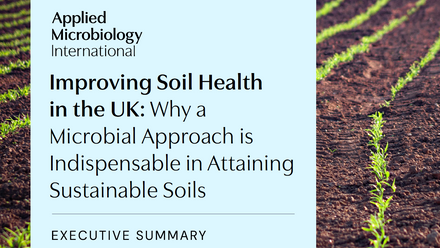
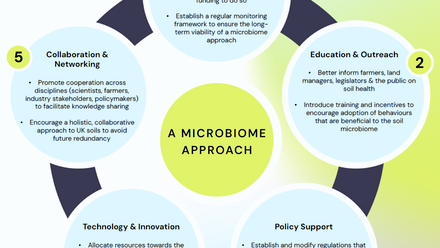
Find out more by reading the full paper or perusing its executive summary below:

Roundtable
In September 2025, we hosted a virtual roundtable chaired by Dr Marcela Hernández, bringing together 34 participants representing academics, governmental and nongovernmental organisations, research institutes, agri-businesses and union representatives.
The roundtable was convened following the distribution of our journal article to various stakeholders, including the UK Government, research institutes and NGOs. Over 20 meetings were held with those interested in discussing our recommendations further. Three key cross-cutting themes emerged from these meetings, which formed the basis of the roundtable:
- The need to agree on a cross-disciplinary definition for 'healthy' soil
- The need to determine the most promising and/or suitable biological and microbiological indicator/s for soil health
- The need to discuss the original brief's recommended microbial solutions for sustainably managing soils, refining them based on multi-disciplinary input and perspectives (and potentially expanding them beyond the agricultural setting).
Report
This policy report, Improving Soil Health in the UK, summarises the roundtable discussions. See the full report below as well as its Executive Summary which highlights the report’s recommendations and key message around the need for policymakers to be more open-minded to risk, to enable wide-scale, lasting change.

Responses
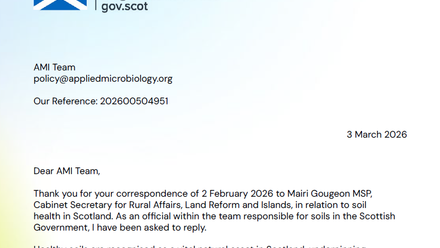
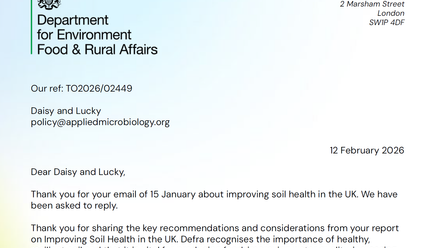
Both AMI’s SMI journal article and policy report were widely distributed to promote the recommendations of the microbiology and wider soil community. The responses we have received to date can be found here.
Our SMI journal article was distributed to over 70 organisations; we received over 20 responses and met with the following organisations:
- CropLife UK, UK Research & Innovation (BBSRC & NERC), Parliamentary & Scientific Committee, Liverpool Research Institute for Climate and Sustainability, Sustainable Soils Alliance, UK Agri-Tech Centre, UK Centre for Ecology & Hydrology, Rothamsted Research, Coalition on Action 4 Soil Health, Soil Association, Wates Group, National Biofilm Innovation Centre, John Innes Centre, UK Environment Agency, & PlantLife.
In addition to the formal responses attached below from Defra & the Scottish government regarding our policy report, we heard from the following organisations:
- The Parliamentary and Scientific Affairs Committee published the executive summary on their website.
- It was acknowledged by the Office for Environmental Protection and the House of Commons Environment, Food, and Rural Affairs Select Committee.
- NatureScot thanked us for sharing and indicated they will be using it to guide internal discussions on soil health and its relation to nature conservation priorities.
- A member of the Soil Stars said the report would be helpful input into their communication strategy.
Bacteriophage as an alternative to antimicrobials
Government Inquiries
In 2022, AMI submitted to, and subsequently won, the My Science Inquiry! Our winning pitch – given by Professor James Ebdon – led to an official inquiry on ‘the antimicrobial potential of bacteriophages’, which AMI additionally submitted a response to, which can be found below. The final report published by the Committee can be found via this link, as can the government’s official response, here.


Roundtable Event
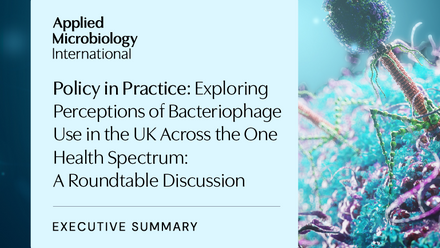
Based on the inquiry’s final report and the UK Government’s official response, AMI hosted a closed policy roundtable, gathering academic experts, regulators, industry and potential phage users to discuss the many potential applications of bacteriophage in a UK context and to form recommendations on how the UK Government could further support their development and implementation.
Journal Article
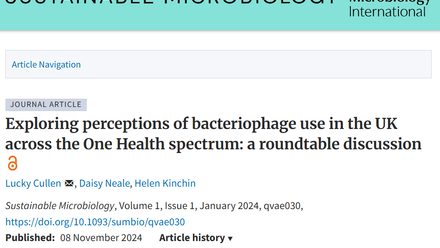
The discussions and resulting recommendations from the roundtable were summarised and published in a policy article in AMI’s Sustainable Microbiology journal. Overall, lack of investment, national infrastructure and public awareness regarding phage therapy, its development and its potential, were agreed upon as the key barriers that need to be overcome to more widely implement phage therapy across the UK.
Responses
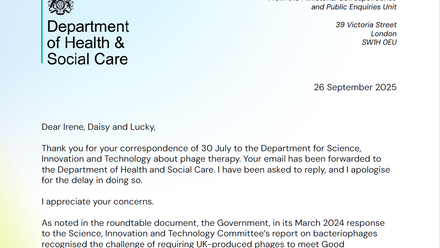
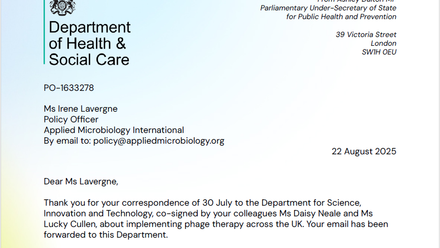
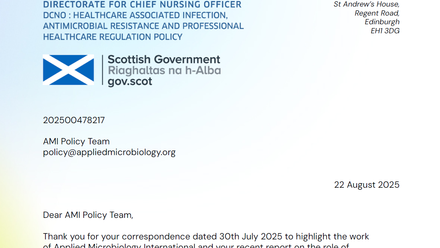
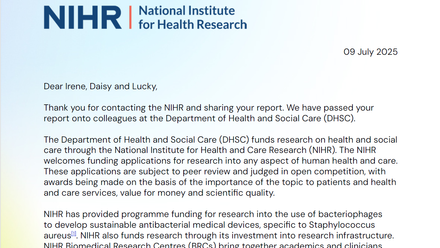
This SMI Journal article was widely distributed to promote the recommendations of the One Health microbiology community. The responses we have received to date can be found here. In addition to these comprehensive responses, we heard back from the following organisations:
- Research Scotland
- UK Medicines and Healthcare products Regulatory Agency
- NHS Scotland
- UK Health, Social Care and Sport Committee
- Parliamentary Office of Science and Technology
Analysing Global AMR Policies
GAP-AMR Roundtable
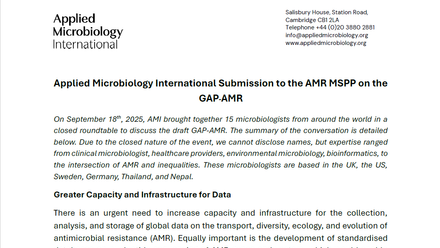
In September 2025, AMI brought together 15 microbiologists from around the world—including experts from the UK, India, Nepal, Thailand, the US, Sweden, Lebanon, and Germany—for a virtual roundtable discussion on the strengths and weaknesses of the draft Global Action Plan on AMR. The group represented diverse areas of expertise, spanning clinical and environmental microbiology, bioinformatics, and the intersection of inequalities and AMR. Discussions resulted in multiple recommendations from the microbiology community to help policymakers strengthen current global AMR policy, which can be found summarised in AMI’s consultation response.

GAP-AMR Consultation Responses
You can read AMI’s official submission to the consultation on the Global Action Plan on AMR below, as well as an expanded version which was sent to provide further evidence beyond the consultation’s word limit:

Roundtable UK NAP-AMR
In November 2022 AMI organised a policy roundtable to discuss the United Kingdom’s 5-year National Action Plan to address AMR. With the 2019 – 2024 NAP coming to an end, an addendum was published with several new and revised commitments ahead of the next 5-year NAP’s development. AMI took the opportunity to invite UK experts from across the human and animal sectors to discuss their thoughts on progress to date and form recommendations for policymakers going forward.
Journal Article UK NAP-AMR
A summary of the roundtable’s discussions and resulting recommendations were published in AMI’s Sustainable Microbiology journal, see below:



Video
This short video summarises AMI's soil related policy work from 2023 to 2026.